

Retro formats
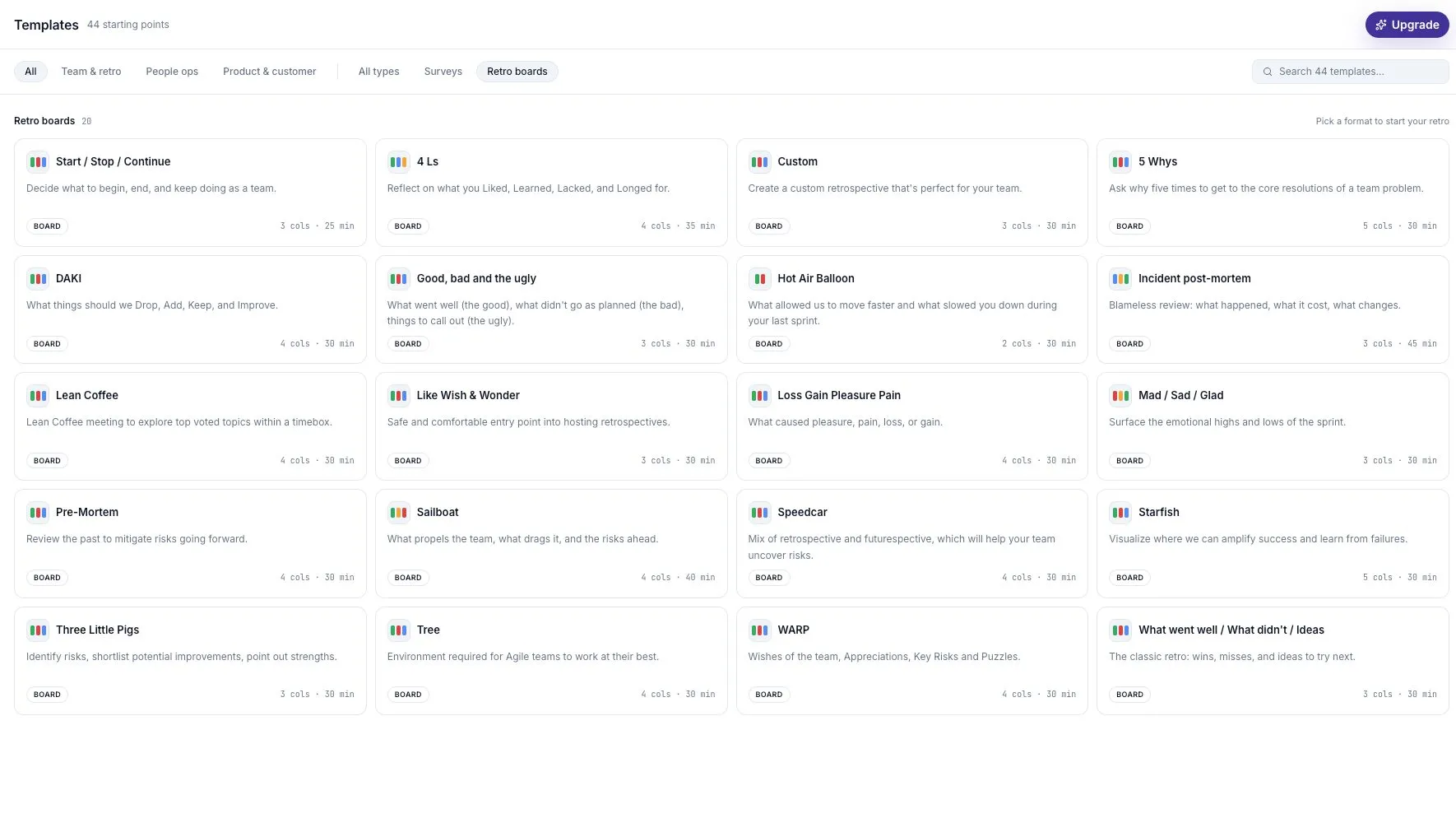
Every retro format ScatterSpoke ships — its columns, its typical run length, and what a board inherits from it.
A format is the template a retro board is created from. It supplies the board’s columns — their titles, their colours, their order, and an optional prompt line under each header — and a typical run length.
Formats are browsed in the templates gallery under Retro boards, reached from New retro.
What a board inherits
Section titled “What a board inherits”| From the format | Fixed after creation |
|---|---|
| Column titles | No; the facilitator can rename them |
| Column colours | Yes |
| Column order | Yes |
| Column prompt lines | Yes |
| Typical run length | Not applied to the board; shown while choosing |
| ”Best for” line | Not applied to the board; shown while choosing |
On an active board, the creator or facilitator can rename columns, add columns, and remove empty columns. Reordering and recoloring are not available. See Cards, columns, votes, and comments.
Run style, phase, access mode, privacy, and vote budget are not part of the format. Every board starts Guided, in Feedback, workspace access, attributed, private until reveal, with 5 votes per person, whichever format it came from.
Core formats
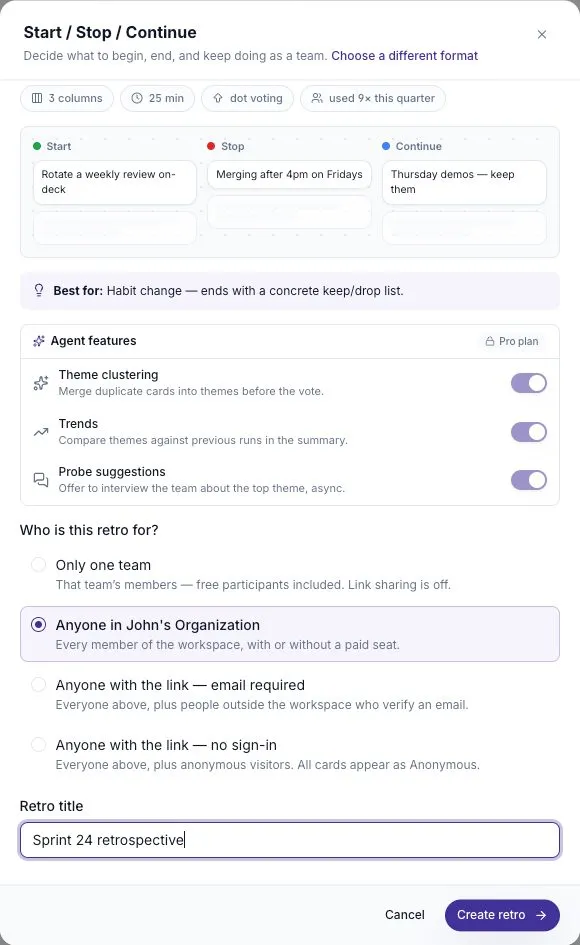
Section titled “Core formats”Six formats carry prompt lines, sample cards in the gallery preview, and a “Best for” hint.
| Format | Columns | Typical | Prompts | Best for |
|---|---|---|---|---|
| Start / Stop / Continue | Start · Stop · Continue | 25 min | Yes | Habit change — ends with a concrete keep/drop list. |
| Mad / Sad / Glad | Mad · Sad · Glad | 30 min | Yes | Sprint-end team health — gets feelings on the table fast. |
| 4 Ls | Liked · Learned · Lacked · Longed for | 35 min | No | Deeper reflection — good for quarter or project ends. |
| What went well / What didn’t / Ideas | Went well · Didn’t · Ideas | 30 min | No | The classic. Low ceremony, works for any team. |
| Sailboat | Wind · Anchors · Rocks · Island | 40 min | Yes | Forward-looking — surfaces risks, not just gripes. |
| Incident post-mortem | What happened · Impact · What we’ll change | 45 min | Yes | After an incident — blameless, timeline-first. |
Additional formats
Section titled “Additional formats”Fourteen further formats, each with a typical run length of 30 minutes and no per-column prompt lines.
| Format | Columns |
|---|---|
| Custom | Column 1 · Column 2 · Column 3 |
| DAKI | Drop · Add · Keep · Improve |
| 5 Whys | Why? #1 · Why? #2 · Why? #3 · Why? #4 · Why? #5 |
| Good, bad and the ugly | The Good · The Bad · The Ugly |
| Hot Air Balloon | Fire and Hot Air · Weights that Pull Down |
| Lean Coffee | Brainstorm · To Discuss · Discussing · Discussed |
| Like Wish & Wonder | I Like · I Wish · I Wonder |
| Loss Gain Pleasure Pain | Loss · Gain · Pleasure · Pain |
| Pre-Mortem | Risks · What the team can control · What the team can’t control · Solutions |
| Speedcar | Parachute · Engine · Abyss · Bridge |
| Starfish | Keep Doing · Start Doing · Stop Doing · More Of · Less Of |
| Three Little Pigs | House of Straw · House of Sticks · House of Bricks |
| Tree | Tree · Fruits · Roots · Sun/Water |
| WARP | Wishes · Appreciations · Risks · Puzzles |
Column count and layout
Section titled “Column count and layout”| Columns | Board layout at 780px and above |
|---|---|
| 2 or 3 | Three-column grid |
| 4 or more | Four-column grid, wrapping |
On a narrow screen, columns appear as full-width lanes. Move horizontally to read the next column.
The five-column formats — 5 Whys and Starfish — therefore lay out as four across with the fifth below.
Custom
Section titled “Custom”Custom is the generic three-column format. Its columns are named Column 1, Column 2, and Column 3, and the facilitator can rename them after creating the board.
It is also the fallback for boards migrated from the older ScatterSpoke whose original format has no equivalent here. See Migrating legacy boards.
Usage counts
Section titled “Usage counts”Each format card shows how many boards were created from it in the current quarter, across your workspace. The gallery’s featured row surfaces the most-used format with a badge.