

The Feedback phase
The first phase of a guided retro, where everyone writes cards — and why new boards keep those cards private until the facilitator reveals them.
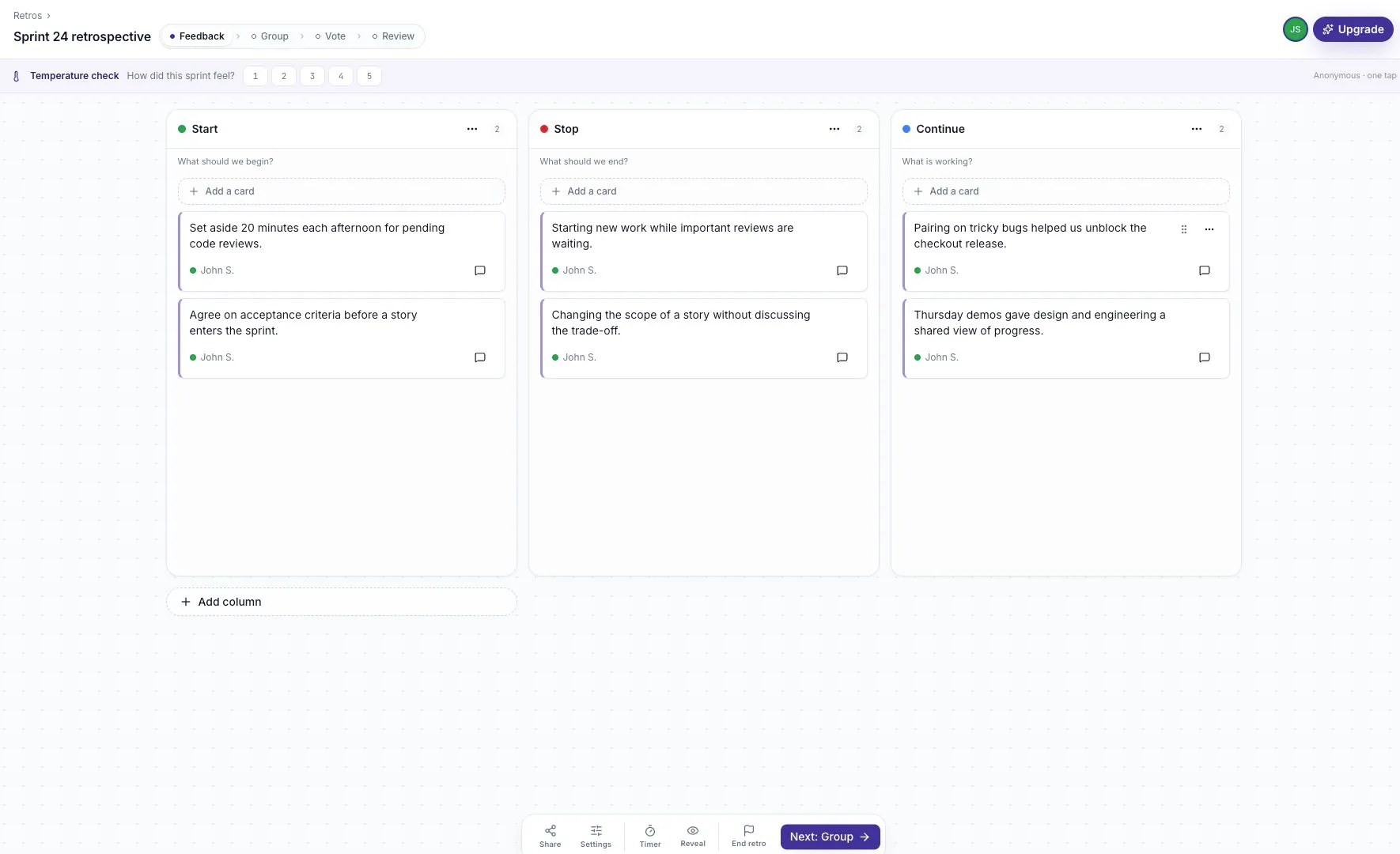
Feedback is where the material comes from. It’s the first of the four guided phases — Feedback → Group → Vote → Review — and the phase every board opens in.
The job of this phase is to get what people actually think onto the board before anyone reacts to it.
What people can do
Section titled “What people can do”Adding cards is the phase’s activity, and it’s gated to it: on a guided board the Add a card box appears in each column during Feedback and disappears afterwards. Each column shows its format’s prompt under the header — What frustrated you?, What slows us down? — while people can still write.
People can edit and delete their own cards, and drag them between columns, at any point while the board is live. Only the creation of new cards is tied to the phase.
Vote totals are hidden here
Section titled “Vote totals are hidden here”During guided Feedback, cards show no vote counts at all — not even zeros. With the default Blind voting setting, totals stay hidden through Vote and appear in Review.
This is deliberate. A card that arrives with three votes already on it changes how the next person reads it, and the earliest cards would collect votes simply for being early. This gives people time to choose without following early votes.
Private until reveal
Section titled “Private until reveal”New boards are created private until reveal, and this is the phase where that matters.
While a board is private and unrevealed, a participant sees their own cards normally and everyone else’s as a grey Feedback hidden until reveal placeholder — no text, no author, no vote or comment controls. Participants can read the other cards once the facilitator reveals the feedback. Check anonymity separately; hiding cards until reveal does not hide author names afterwards.
The facilitator’s Reveal button in the dock opens everything at once, for everyone. It appears only while feedback is private and unrevealed, and disappears permanently once used — reveal is one-way for the session.
The reason to run this way is anchoring. When cards are visible as they’re typed, the room converges: the second person writes a version of what the first person wrote, and the loudest theme in the first ninety seconds becomes the theme of the retro. A private write followed by a single reveal gets you genuinely independent input.
The reason not to is momentum. A team that’s already comfortable, or a continuous board people add to across a sprint, is better served by always-visible feedback — people build on each other rather than duplicating. Turn Private until reveal off in the dock’s Settings.
Full detail in Private feedback and anonymity.
The temperature check
Section titled “The temperature check”If the board is in Feedback and you haven’t answered yet, a one-tap strip sits under the top bar: How did this sprint feel? with buttons 1 to 5. Answering dismisses it and replaces it with the room’s running average.
Answers are recorded per participant but only ever read back as an aggregate. See Moods and temperature checks.
Nudging the quiet
Section titled “Nudging the quiet”About five seconds into the phase, a facilitator whose room isn’t all contributing sees a chip above the dock — “3 people haven’t added a card yet” — with a Nudge them action. The nudge reaches only those people, as a quiet prompt. Nobody is named on the board.
The counts come from the server, not the facilitator’s own view of the board: on an anonymous or private board the client genuinely cannot tell who has written and who hasn’t, so this is the only way the chip could be honest.
Moving on
Section titled “Moving on”When the writing is done — the timer runs out, or the room goes quiet — reveal, let people read, then advance to Group to organize related feedback before voting.
Don’t advance and reveal in the same breath. Two minutes of silent reading between them is what stops the vote from being a popularity contest for whoever spoke first.